


The Invention
Newtom created the first dental CBCT Cone Beam unit. A device that has radically reshaped the world of dental X-ray imaging – allowing volumetric reconstructions of anatomical parts to be carried out for dentistry and imaging centre applications.
The Business
Newtom offers innovative 2D/3D imaging devices designed to revolutionise the world of dental X-ray and maxillofacial diagnostics. X-ray imaging tools, whose outstanding performance expand diagnostics prospects by adding enterprising value to dental clinics and radiology practices.
The Patents
Every day, Newtom confirms its market-leading position thanks to its expertise and know-how established in over twenty years of investment in patents, inventions and models.
A 30-Year Journey of NEWTOM Innovation
2026 - GiANO HR FullView

2025 - VG-One
Newtom continues its innovation trajectory with the launch of the VG-One, a new-generation platform designed for practices seeking high performance in a compact footprint. The VG-One combines refined 2D and 3D imaging with intelligent dose-adaptation, ensuring consistently sharp images while maintaining exceptional patient safety.
Powered by Neowise, advanced AI software, the VG-One streamlines acquisition, enhances visualisation and simplifies workflow, bringing sophisticated imaging capability to more practices than ever before.

2024 - 7G Dual Energy: A New Benchmark in Whole-Body CBCT
In 2024, NewTom expanded the limits of CBCT with the release of the 7G with Dual Energy, introducing advanced material differentiation and enhanced diagnostic accuracy across a wide range of clinical applications. By capturing two complementary energy datasets of the same anatomical region, Dual Energy technology allows clinicians to distinguish tissues with greater precision, reduce artefacts, and optimise image interpretation. The 7G with Dual Energy sets a new standard for whole-body CBCT, making it a powerful second CT scanner solution for MSK, ENT, dental, maxillofacial and paediatric imaging.

2020 – 7G
For the very first time, cone beam technology can be applied to all areas of the body, including spine, shoulder and hip with the 7G.
Equipped with an extremely high-performance X-ray generator (up to 120kV and 120mA) and independent selection of the focal spot (0.3mm or 0.6mm), The 7G lets users perform accurate bone tissue examinations at a resolution of up to 90 µm, ensuring ultra-precise analysis of even very small complex structures such as those of the inner ear. The ability to perform exams quickly in “Low Dose” mode – with acquisition of the desired anatomical area in just 7 seconds – is particularly convenient. Cine-Scout, CineX and Ray 2D protocols complete the range of clinical applications.

2019 – GO 2D/3D CEPH
Advancing on the GO 2D, the GO 2D/3D CEPH was developed as a flexible platform that comes ready for the optional integration of the telradiographic arm in a 2D or 3D configuration. Imaging excellence combined with the versatility of a complete and safe, technologically advanced system.

2018 – GiANO HR
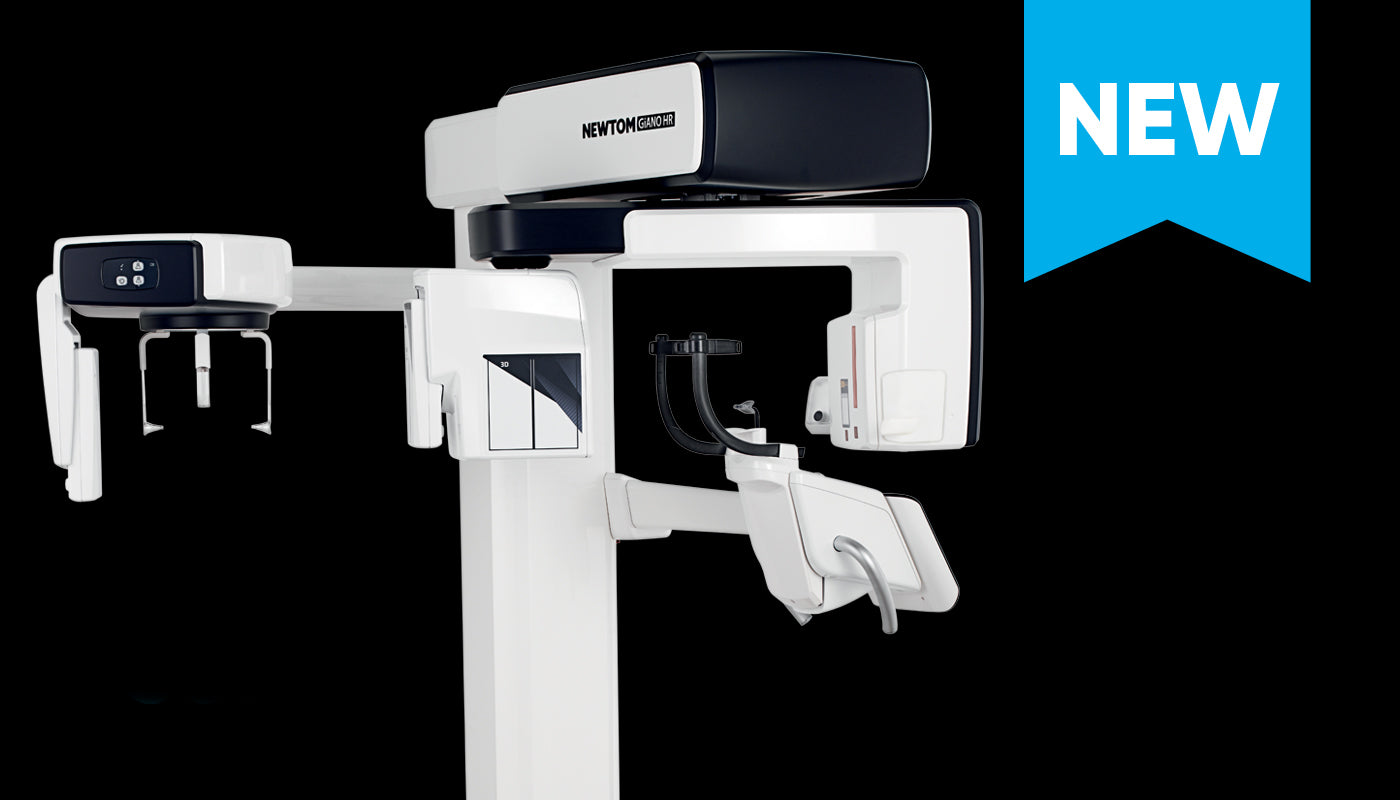
The GiANO HR is a revolutionary 3-in-1 device for 2D/3D imaging. Dedicated sensors for both 2D and 3D protocols guarantee an excellent image quality. The GiANO HR is Newtom’s versatile and updatable device for all radiology-related needs. It offers specific multiple volumetric examinations for maxillofacial surgery, otorhinolaryngology and cervical spine examinations. Three models are available in the 3D configuration, according to the FOV:
- 3D Prime max FOV 10 x 8 cm
- 3D Advanced max FOV 13 x 16 cm
- 3D Professional max FOV 18 x 16 cm

2015 – 5G XL
The 5G XL is the first device with native FOV 21 x 19cm for highly detailed investigations. The ideal device that produces clear, high-definition images for orthopaedics, otorhinolaryngology, maxillofacial surgery and dentistry application. The only CBCT device with lying down patient positioning that offers excellent stabilisation and a broad range of FOVs for very high-quality 3D images, providing even more advanced diagnostics. Thanks to the modern sensor and the new model of X-ray tube, the 5G XL also allows high quality 2D and x-ray video imaging.

2015 – GO 2D
The GO was designed for dental practices that require a compact, easy-to-use, innovative, reliable product that guarantees only the very best diagnostic results at an affordable price.
Absolute image quality guaranteed by cutting-edge Newtom technology – easy patient positioning and the certainty of the diagnostic outcome allow the dentist to work calmly and time-efficiently. The device adapts to all the different needs of a clinic by providing a selection of 22 programs. And thanks to the Ethernet connection, the GO can be remotely controlled with a user-friendly virtual control panel.

2014 – VGi EVO
The engineering evolution of the Newtom range has delivered an ultra-modern, ultra-technological, ultra-competitive device with the VGi EVO - the most complete CBCT.
- Choice of Eco Scan modes for each FOV, for carrying out scans with reduced dosages to the patient
- Maximum FOV 24x19 cm, with a single scan
- Various functions available: 3D imaging, panoramic imaging, teleradiography and 2D sequential imaging
- Modern ergonomics to gather all the top technology into a reduced space
- Simple and comfortable patient positioning, thanks to the latest generation head support unit

2012 – GiANO
Thanks to Newtom's high technology and competitive price, the GiANO was considered the most competitive hybrid available. The specialist had at his disposal a device which performed a wide range of exams depending on requirements: 2D, 3D, Ceph and carpal exams. The GiANO with a 2D configuration could be enhanced to 3D or Ceph at any time. Thanks to the modular sensor, which could easily be switched and used on the Ceph head, the short exam time and the low dose, GiANO offers a more complete and immediate diagnosis.
2010 – 5G (MED & VET Applications)
The 5G, with its revolutionary patient table, allowed the development of Cone Beam technology in new fields of application. Following customers suggestions, Newtom applied the potential of their device to medical radiology, with excellent results. Practitioners could explore new clinical applications, thanks to the open, pass-through style gantry and motorised, reclining patient’s chair. The supine position of the patient during the scan and the reduced scan time added comfort and stability and excellent results in terms of image quality and patient satisfaction.s.
2009 - VGi & VGi Flex
In 2009 the VG was upgraded and it was named VGi (Vertical Generation Improved). For even more precise measurements and treatment plannings, the new HiRes Zoom (0.075mm) feature provided 50% higher image resolution and a 50% reduced slice thickness. The VGi also featured crosshair lasers and a mirror- powerful tool for exact horizontal and vertical positioning. It featured 5 different FOV.
2008 – VG Flex
The VG Flex had all the features of the VG unit. With one-button calibration and a simple, fast warm-up period, the VG Flex made going on the road easy. It fit in a variety of vehicle configurations to suit needs, making the VG Flex the cone beam 3D machine that went where you wanted your practice to go.
2007 – VG
2007 represented a turning point for Newtom when the first model of VG (Vertical Generation) was released. It was designed for dental practices, where smaller spaces and lower budgets were among the main requirements. The VG allowed specialists of various fields (implantology, maxillofacial surgery, orthodontics, etc.) to use 3D images for treatment analysis. It was one of the first vertical CBCT devices and it was characterised by a flat panel detector and a very small focal spot.
2004 – 3G
The 3G (Third Generation) was the evolution of the DVT 9000. It could count on three fields of view (6”, 9” and 12”), all available in one machine. On the market, the 3G was the one that could offer the largest FOV and the largest reconstructed volumes (20cm Ø). It also allowed to select smaller regions of interest. With one 3G scan, an unlimited number of diagnostic images were created: cephalometric, panoramic, cross-sectional, axial, sagittal, coronal and 3D images.
1996 – DVT 9000
The DVT 9000 was the first cone beam device designed for the dental field. It was a revolution because its exposure and the scan time were lower than a conventional CT. The patient was placed horizontally, and a laser positioning system aided the operator. It had a unique feature that allowed a complete 3D reconstruction. 9000 could create a reconstructed panoramic and it could mark the mandibular canal.